Saturday, May 2, 2026
Home Blog Page 17

Amplitude Modulation

In communication a carrier signal is a sinusoidal signal denoted by

C(t)=Ac Cos(2á´¨fct)

Ac= Amplitude of the carrier

C(t)= carrier signal

fc= carrier frequency

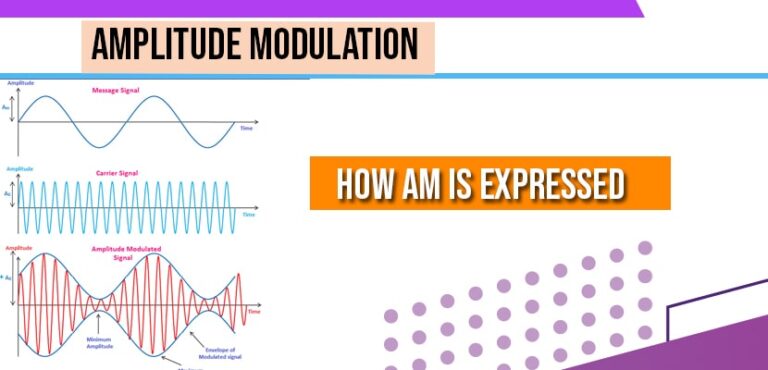
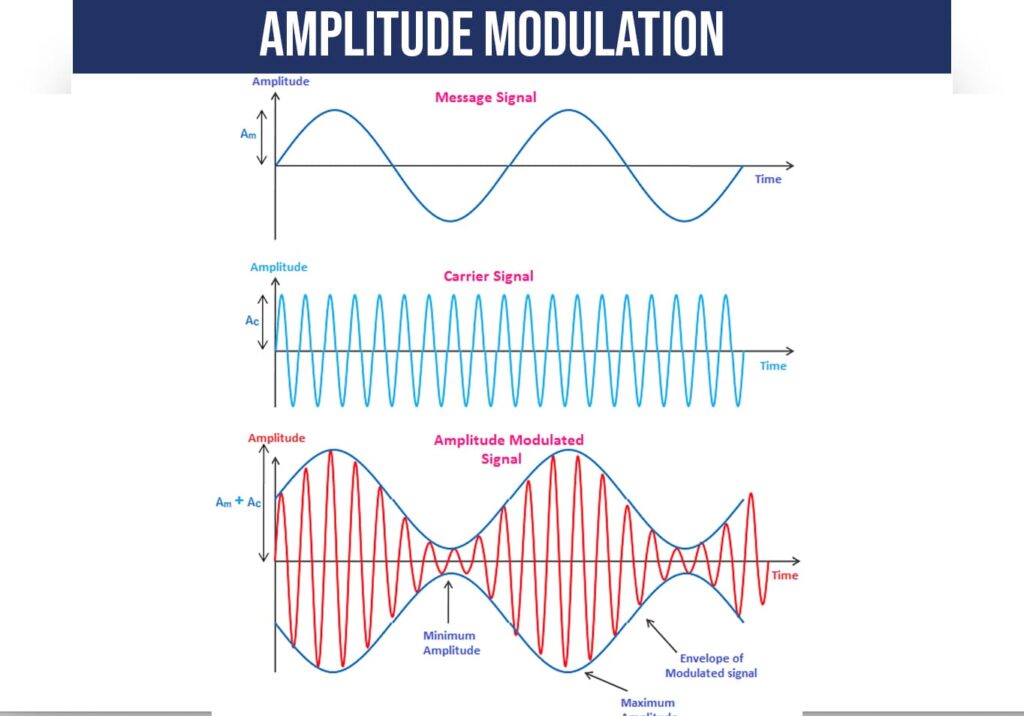
This carrier signal is fundamental in any communication system message signal or baseband signal is modulated. There are many ways to modulate the signal one among them is Amplitude modulation. In Amplitude modulation the carrier signal is modulated buy message signal or baseband signal. Or in other way Amplitude modulation is a process in which the amplitude of the carrier signal is varied instantaneously in accordance with the baseband signal keeping phase and frequency constant.

How Amplitude Modulation is Expressed

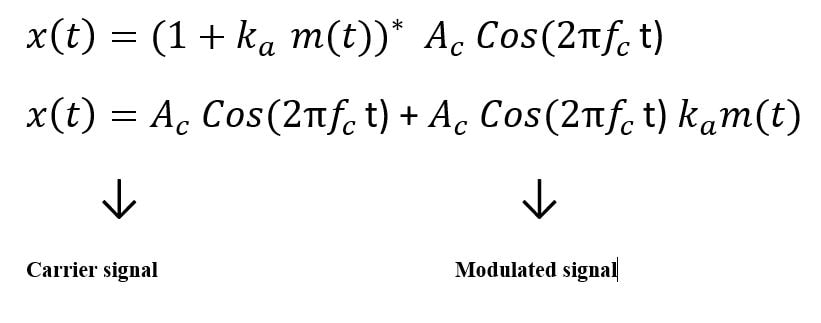
AM signal is expressed as:

ka= sensitivity of the AM signal

m(t)=message to be transmitted

In amplitude modulation what actually happens is that we have message signal which has the message to be transmitted and also carrier signal, when we multiply this carrier signal; by message the amplitude of the carrier which is constant varies according to the message.

Benefits of modulations and its Techniques

Modulation allows you to transmit information using radio signals and benefits of modulation includes height of the antenna is reduced, it reduces the interference among the signals, mixing of signals is reduced, multiplexing of signals is possible, long distance communication is possible.

Benefits of Modulation

1 .Height of the Antenna is Reduced:

We know that there are transmitting and receiving antennas for transmission and reception of signals. The condition for efficient transmission and reception is that the antenna height must be the  multiples of λ/4.

λ=c/f

λ= wavelength of the frequency

c=speed of light=3*108m/s

This implies that the antenna height and wavelength are inversely proportional. In practical by using the above formula for antenna height it is impossible to construct the antenna with the obtained output height therefore by  using some modulation height of the antenna is reduced.

2. Reduces the Interference Among the Signals:

Interference can b reduced among the signals by modulating each baseband signal with different frequencies of carrier signal so that each baseband signal has different frequency slots so that many signals can be transmitted simultaneously.

3. Mixing of the Signals is Reduced:

If the baseband signals are transmitted without modulation all the signals gets mixed as they have same frequency range. With modulation this problem is solved.

4. Multiplexing of the Signals is Possible:

With modulation many signals can be transmitted over a single channel receiver receives those signals and separates them using band pass filter.

5. Long Distance Communication is Possible:

Baseband signals have low frequency range these low frequency signals experiences attenuation when they are transmitted to longer distances  therefore they travels only short distances. Modulation increases the frequency of the baseband signals and allows to travel  longer distances

Definitions:

Carrier Signal:

carrier signal is an  alternating empty signal with higher frequency used for carrying the information.

Modulating Signal:

The signal that is to be modulated is called modulating signal

Modulated Wave:

The signal that is obtained after modulation process is known as modulated wave.

Multiplexing:

Multiplexing is the process of transmitting multiple signals over a single communication channel.

Questions:

 1. What is modulation? Why do we need modulation?

2. Benefits of modulation or advantages of modulation?

3. Define the terms signal, carrier signal, modulating signal, modulated wave?

4. Define the term multiplexing.

Modulation Techniques:

Two types of modulation techniques and they are Analog modulation and Digital modulation. Firstly we discuss Analog modulation techniques later we move on to Digital modulation techniques.

Analog modulation techniques:

1. Amplitude Modulation

2. Frequency Modulation

3. Phase modulation

What are signals and classification of signals

What are Signals

Anything that carries information is called signal. It may also be defined as any physical quantity that varies with time, space or any other independent variable. If signal depends only on one independent variable it is called one dimensional signal and if the signal depends on two independent variables then it is two dimensional signals. Signals may be represented in time or frequency domain.

Classification of Signals

Signals can be classified in to two type and they are:

  1. Continuous time signals
  2. Discrete time signals

Continuous Time Signals

Continuous time signals are defined for all instants of time. These are represented by x(t),t is an independent variable in time domain. Continuous time signals are represented by a function or graph.

Discrete Time Signals

Discrete time signals(DTS) are defined only at discrete instants of time. These are represented by x(n).’n ’is an independent variable in time domain. There are four basic ways of representing DTS they are graphical, function, tabular and sequence.

Attenuation

Attenuation is the loss in the strength of the signal or amplitude of the signals it travels through the channel. Noise, long distances causes the attenuation of the signal.

Amplification

Amplification is the process of increasing the amplitude of the signal by the given factor.

Bandwidth

Bandwidth is defined as the difference between upper and lower frequencies of the signal.

Modulation

Modulation is the process of changing the characteristics of the carrier signal with respect to the original base band signal. There are different types of modulations Amplitude modulation, Frequency modulation and Phase modulation that we will discuss  them in detail further.

Demodulation

Demodulation performs reversal operation of modulation. It retrieves the original message signal from the modulated signal using some demodulation schemes.

Repeater

Repeater is used to strengthen the received  signal and retransmits it over long distances.

The terms transducer and receiver are explained in the previous topic.

 Why signals need to be modulated?

We know that baseband signals transmitted by the transmitter is received by the receiver. You might be having a question that when the baseband signals can be transmitted directly to the receiver then what is the need of modulation? Let us assume that if all the baseband signals are transmitted over a single transmitter then what happens is that all these signals are combined as they have the same frequency range. Due to this combining the information carried by those signals gets overlapped and sent to the receiver it is difficult to the receiver to separate these combined signals. Therefore each baseband signal has to be modulated for efficient transmission.

Frequently Asked Questions:

What is signal?

Anything that transmits information is called signal.

What are the 2 types of signals?

Continuous time and discrete time signals.

What is continuous time signal?

Continuous time signals are defined for all instants of time.

What is discrete time signals?

Discrete time signals(DTS) are defined only at discrete instants of time.

Electric Field and Intensity of Electric Field

0

Electric filed

The region surrounding an electric charge or a group of charges, in which another charge experiences a force us called electric filed.

The force between two charges can be considered in terms of electric filed are as follows.

1) The charge q1 sets us an electric filed in space itself.

2) The field of q1 acts on q2, now q2 experiences a force, so the force on q2 is due to the action of field of q1 and q2.

We can also imagine that q2 sets up the field and this field acts on q1, thus produces a force on q1.

Suppose, a receiving antenna is placed in the field of a transmitting antenna. Let at once particular instant, the filed transmitting antenna reaches the receiving antenna. This reaches after a time l/c where l is the separation between two antennas and c is the velocity of light. The filed induces e.m.f in the receiving antenna. The delay in action confirms the intermediatory role of the filed in the forces between the charges.

Intensity of Electric Field E

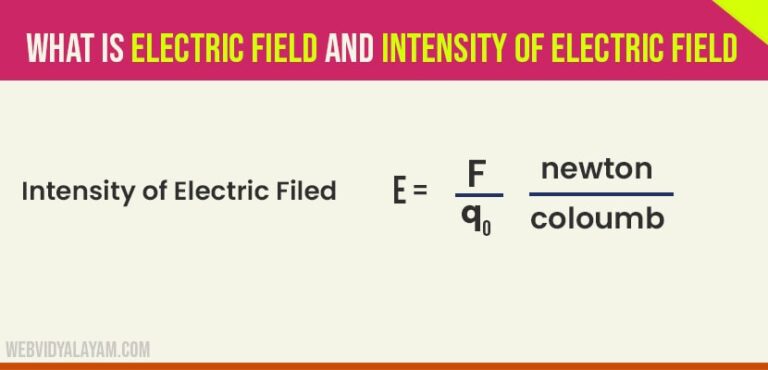
The intensity of electric field at a point in the field is defined as the force experienced by a unit positive charge placed at that point.

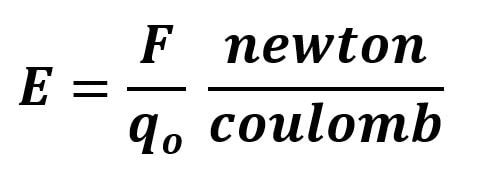
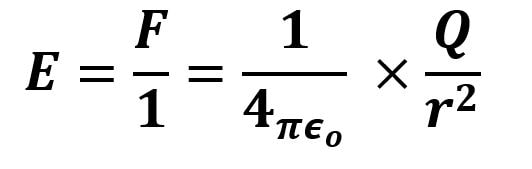
Let F be the force experienced by a test charge qo placed at a point in the electric filed, then the intensity of electric filed R at that point is given by:

It is obvious that intensity of electric filed is a vector quantity. Its direction will be the same as the direction of force. i.e the direction in which the positive charge placed in the filed tends to move. The unit of electric field is newton per coulomb

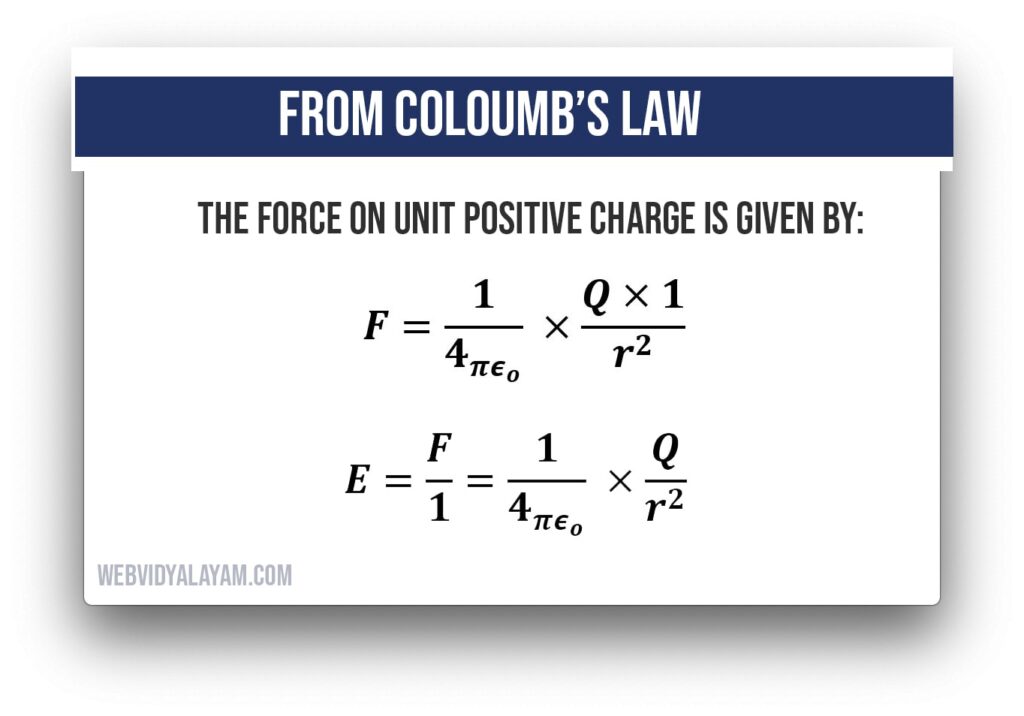
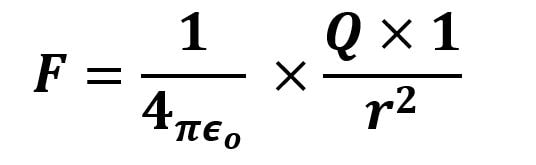
Let us consider that a unit positive charge is placed at a distance r from a point charge Q in air. From coulomb’s law, the force on unit positive charge is given by

What is Communication System

Communication System

When we are exchanging information or sharing information with someone for example by speaking, writing or sending radio signals or in any form and the process of exchanging information or sharing is called as communication system.

How can we exchange information

We can exchange information by using phone, writing, radio signal, electronic messages, digital messages etc and if one person is speaking to other person this is said to in person communication and there are plenty of examples and number of ways one person can communicate from other.

Before entering deep into this topic we need to know about some basic terms related to this communication system. In general all we know that communication is a process of sharing or transferring or exchanging the information or message or data from one point to another point or from one end system to other end system.  All we need to know that how this communication takes place.

Communication in Olden Days

In olden days communication is done through human (i.e., to transfer the message from one person to other person, third person is required for carrying the information from source person to destination person). This is known as physical mode of communication because here the data is physically carried by the person and non-verbal communication can also be referred as physical mode of communication. (In Physical mode of communication the speed is very limited), cost is high and also the reliability of the service is poor.

Communication System In Present Days

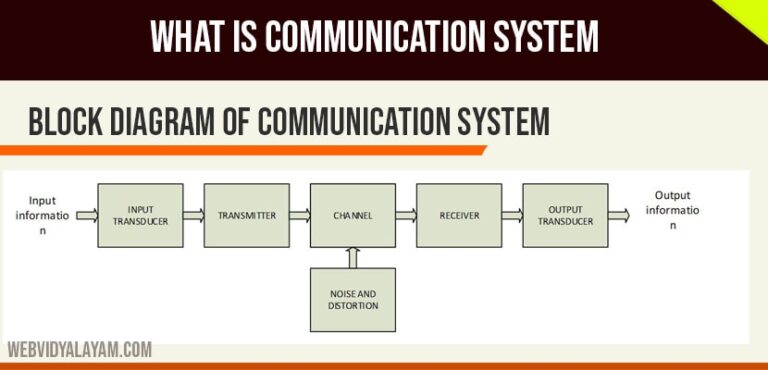
But the situation today in present days are completely different. we can communicate across the world to any place within seconds. The question is how this become possible? What development has made behind to reach this situation? We are going to discuss the history behind this modern communication system or electronic communication system. Lets get started with the baic block diagram of the modern communication system and also discuss each block in detail.

Block Diagram of Communication System

Figure 1 BLOCK DIAGRAM OF ELECTRONIC COMMUNICATION SYSTEM

Channel

First we start with the block channel. Remember communication is the process of imparting or exchanging the information from one place to other. Here the information that is produced by the source (i.e., transmitter side) has to travel several thousands of miles to reach the destination(i.e., receiver).Channel is the media through which this information is passed, this channel may be a wired example copper wire or wireless example air. In wired channel  a dedicated cable is connected between the transmitter and the receiver where as in wireless it travels through the air. For short distances wired connection is preferable whereas, for larger distances wireless is used because it is difficult  to have a dedicated wire or cable for long distances as it requires larger wire due to this the equipment becomes complex and for even far areas it is impossible to have a wired connection.

Noise and Distortion

Noise

Noise is an unwanted interference caused by some internal and external factors. Noise due to internal factors such as motion of electrons ,recombining of carriers is known as internal noise and noise caused by external factors such as ignition, lightening, electrical switching is known as external noise.

Distortion

Distortion is different from noise. distortion misleads the destination about the input signal by changing the characteristics of the input signal such as amplitude, frequency and phase. If this distortion parameters vary linearly known as linear distortion and nonlinearly known as non-linear distortion.

Input and Output Transducer

Transducer is a device used to convert one form of the information to other form. The information that is to be transmitted is first converted into electrical form. This conversion is done by the input transducer the need of this conversion is to deliver the information with high speed. Electrical signals moves with a speed equal to the speed of light. The output transducer performs the replica operation to that of input transducer it converts the electrical signal from channel to the corresponding form that user requires.

Transmitter

Transmitter modifies the input electrical signal to the form that is suitable for efficient transmission over the given channel. We have different types of transmitters for different types of channels. If the channel varies it is the responsibility of the transmitter to adjust itself  with the varied channel for efficient communication. In general, this transmitter section contains several sub blocks such as modulator, A/D converter , encoder, amplifier.

Receiver

Receiver performs exactly the inverse operation of transmitter. It modifies   the  received electrical signal to the form that user  understands. It also performs decoding, D/A conversion, demodulation.

Types of communication System

There are two types of communication system:

  1. Analog communication System.
  2. Digital Communication System

Analog communication

In Analog communication system the information from source to destination is communicated through Analog signals. Analog signals continuous in nature and varies with respect to time. Example speech, video, variation in temperature with respect to time.

Digital Communication

In digital communication system the information from source to destination is communicated through digital signals .Digital signals are discrete in nature and are represented by 0 or 1.Example mobile, Television etc.,

Terminology Used in communication System

The terms used in communication systems are

1. Signal

2. Transducer

3. Attenuation

4. Amplification

5. Bandwidth

6. Modulation

7. Demodulation

8. Repeater

9. Noise

Frequently Asked Questions:

What is communication System:

communication is a process of sharing or transferring or exchanging the information or message or data from one point to another point or from one end system to other end system and the process of exchanging information or sharing is called as communication system.

Common terms related to communication system:

Source, Input transducer, based-band signal, transmitter, Channel, receiver, output transducer, Destination are the common terms used in communication system