

Topology:
The phrase topology is determined as physical the way network is laid; where two or more links form a topology. The reliability and efficiency of a network is depends on its structure. There are four fundamental topologies are ring, mesh, bus and star.
Ring topology:
In this ring topology each node as a dedicated point to point link between each node. While a signal is passed from node to another node until it reaches its destination in the form of ring. In this ring topology each node act as repeater because each node in a ring receives the signal and regenerates the signal and send it to another node. The below figure shows a ring topology.
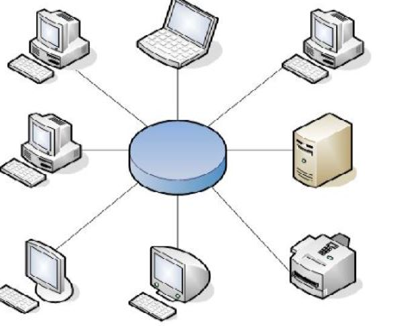
Fig: Ring topology
Some advantages of ring topology are:
- It is easy to install and reconfigure,
- Fault identification is easy.
- It can travel long distance.
Mesh topology:
Mesh topology provides a dedicated point to point link to every node, the word dedicated is defined as which carrier traffic between two nodes. In this mesh topology each node is connected to other node when link fails it does not incapacitate the entire system. Some of advantages of mesh topology are:
It is more robust.
It provide more security and privacy.
With mesh topology fault identification become easy.
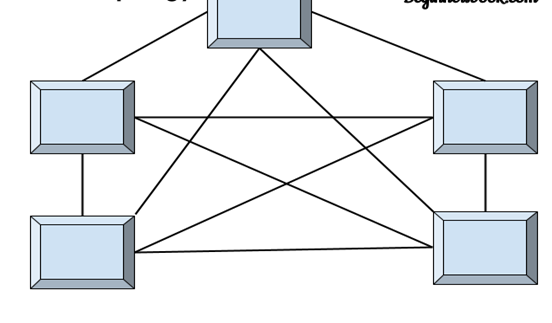
Fig Mesh topology
Star topology:
Star topology is determined as each node provides a dedicated point to point link which is done through a central controller or known as hub. In this each node is not connected with each other directly. In star topology the central hub act as exchanger. When a node want to send a information to another node it first send information to the controller and then controller sends information to the other device. Some advantages of star topology are:
It is less expensive when compared with mesh topology.
It is easy to install and reconfigure.
If one link may fail it does effect other links.
Fault identification is easy.
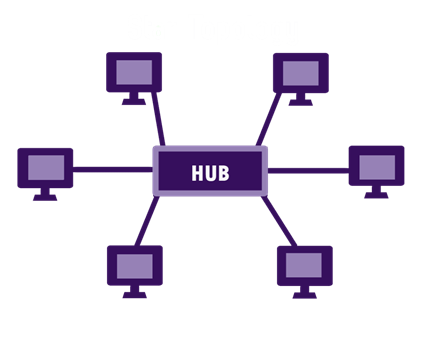
Fig: Star topology
Bus topology:
Bus topology is differ from above three, because it has multipoint configuration. In these nodes are connected to the bus cable by droplines and tap. A drop line is a connection between the nodes and main cable.A tap is a connector used to contact with the metallic core of the main cable and droplines. Some advantages of bus topology are:
Insatallation is easy.
It requires less amount of cables for connection of the computer, and les expensive.
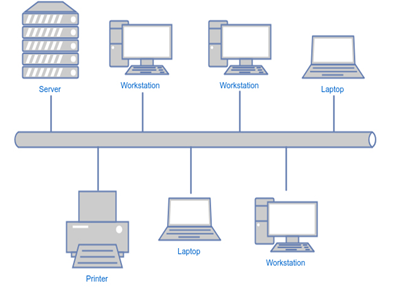
Fig: Bus topology