Saturday, May 2, 2026
Home Blog Page 13

EVEN AND ODD PARTS OF SIGNALS AND SEQUENCE

0

EVEN AND ODD PARTS OF SIGNALS AND SEQUENCE:

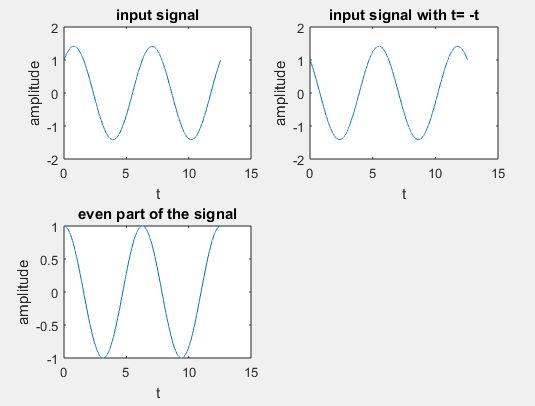
One of the most important characteristic of signal is symmetric which may be useful for signal analysis. When signal is symmetric around vertical axis it said to be even signal, when a signal is symmetric about origin is called odd signal.

Even signal:

When a signal is distinguished as even signal when it satisfies the below condition, for a continuous time signal x(t).

x(t)=x(-t) for all t

When a signal is distinguished as even signal when it satisfies the below condition, for a Discrete time signal x(n).

x(n)=x(-n) for all n

Cosine wave is an example of even signal.

clc;

close all;

clear all;

t=0:.001:4*pi;

x=sin(t)+cos(t); % x(t)=sin(t)+cos(t)

subplot(2,2,1)

plot(t,x)

xlabel(‘t’);

ylabel(‘amplitude’)

title(‘input signal’)

y=sin(-t)+cos(-t); % y(t)=x(-t)

subplot(2,2,2)

plot(t,y)

xlabel(‘t’);

ylabel(‘amplitude’)

title(‘input signal with t= -t’)

even=(x+y)/2;

subplot(2,2,3)

plot(t,even)

xlabel(‘t’);

ylabel(‘amplitude’)

title(‘even part of the signal’)
Odd signal:

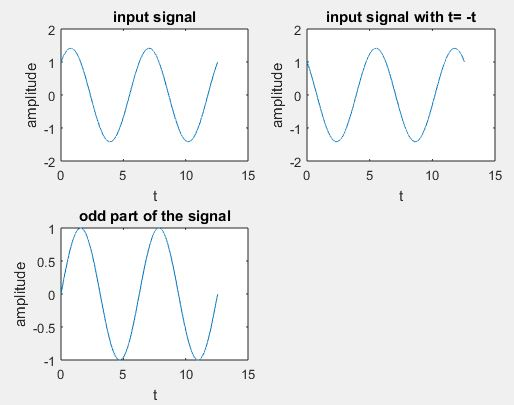
When a signal is distinguished as odd signal when it satisfies the below condition, for a continuous time signal x(t).

x(-t)=-x(t) for all t

When a signal is distinguished as odd signal when it satisfies the below condition, for a Discrete time signal x(n).

x(-n)=-x(n) for all n

Sine wave is an example of odd signal.

clc;

close all;

clear all;

t=0:.001:4*pi;

x=sin(t)+cos(t); % x(t)=sint(t)+cos(t)

subplot(2,2,1)

plot(t,x)

xlabel(‘t’);

ylabel(‘amplitude’)

title(‘input signal’)

y=sin(-t)+cos(-t);

subplot(2,2,2)

plot(t,y)

xlabel(‘t’);

ylabel(‘amplitude’)

title(‘input signal with t= -t’)

odd=(x-y)/2;

subplot(2,2,3)

plot(t,odd)

xlabel(‘t’);

ylabel(‘amplitude’);

title(‘odd part of the signal’);
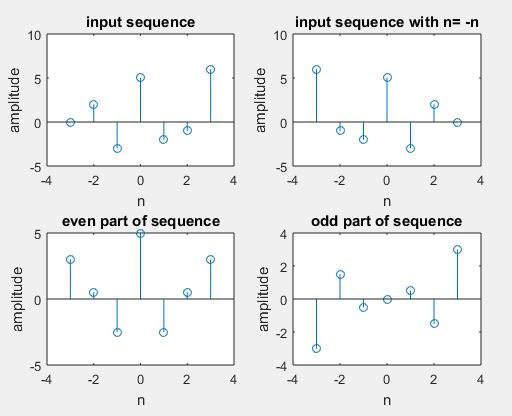
Even And Odd Parts Of Sequence:

clc;

close all;

clear all;

% Even and odd parts of a sequence

x1=[0,2,-3,5,-2,-1,6];

n=-3:3;

y1= fliplr(x1);%y1(n)=x1(-n)

figure;

subplot(2,2,1);

stem(n,x1);

xlabel(‘n’);

ylabel(‘amplitude’);

title(‘input sequence’);

subplot(2,2,2);

stem(n,y1);

xlabel(‘n’);

ylabel(‘amplitude’);

title(‘input sequence with n= -n’);

even1=.5*(x1+y1);

odd1=.5*(x1-y1);

% plotting even and odd parts of the sequence

subplot(2,2,3);

stem(n,even1);

xlabel(‘n’);

ylabel(‘amplitude’);

title(‘even part of sequence’);

subplot(2,2,4);

stem(n,odd1);

xlabel(‘n’);

ylabel(‘amplitude’);

title(‘odd part of sequence’);
Physical Topology

Topology:

The phrase topology is determined as physical the way network is laid; where two or more links form a topology. The reliability and efficiency of a network is depends on its structure. There are four fundamental topologies are ring, mesh, bus and star.

 Ring topology:

In this ring topology each node as a dedicated point to point link between each node. While a signal is passed from node to another node until it reaches its destination in the form of ring. In this ring topology each node act as repeater because each node in a ring receives the signal and regenerates the signal and send it to another node. The below figure shows a ring topology.

Fig: Ring topology

Some advantages of ring topology are:

  • It is easy to install and reconfigure,
  • Fault identification is easy.
  • It can travel long distance.

Mesh topology:

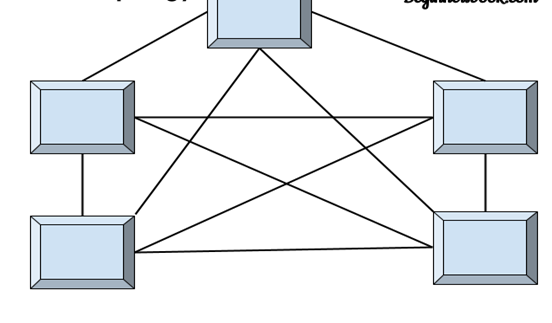
Mesh topology provides a dedicated point to point link to every node, the word dedicated is defined as which carrier traffic between two nodes.  In this mesh topology each node is connected to other node when link fails it does not incapacitate the entire system. Some of advantages of mesh topology are:

It is more robust.

It provide more security and privacy.

With mesh topology fault identification become easy.

Fig Mesh topology

Star topology:

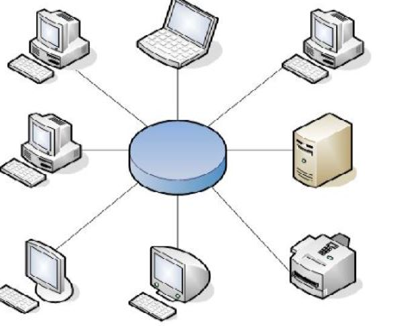
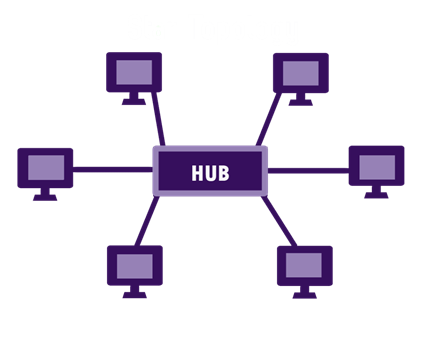
Star topology is determined as each node provides a dedicated point to point link which is done through a central controller or known as hub. In this each node is not connected with each other directly. In star topology the central hub act as exchanger. When a node want to send a information to another node it first send information to the controller and then controller sends information to the other device. Some advantages of star topology are:

It is less expensive when compared with mesh topology.

It is easy to install and reconfigure.

If one link may fail it does effect other links.

Fault identification is easy.

Fig: Star topology

Bus topology:

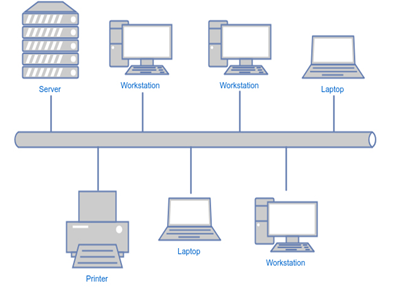
Bus topology is differ from above three, because it  has multipoint configuration. In these nodes are connected to the bus cable by droplines and tap. A drop line is a connection between the nodes and main cable.A tap is a connector used to contact with the metallic core of the main cable and droplines. Some advantages of bus topology are:

Insatallation is easy.

It requires less amount of cables for connection of the computer, and les expensive.

Fig: Bus topology

BASIC OPERATIONS ON SIGNALS

0

BASIC OPERATIONS ON SIGNALS:

When we perform an operation signal it may undergoes several manipulation which may include amplitude of the signal or independent variable. Some basic operation are performed on signals. They are:

Time-shifting:

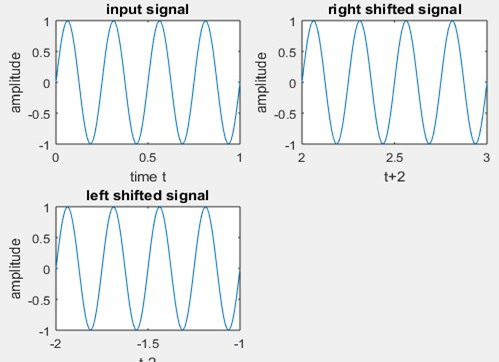
Time shifting of a signal x(n) may be defined as delay or advance of a signal in time, which is represented with the function.

y(n)=x(n+k)

When k is positive, then y(n) is shifted to right then the signal is delayed, when y(n) is shifted to left then the signal is advanced.

clc;

close all;

clear all;

t=0:.01:1;

x1=sin(2*pi*4*t);

%shifting of a signal 1

figure;

subplot(2,2,1);

plot(t,x1);

xlabel(‘time t’);

ylabel(‘amplitude’);

title(‘input signal’);

subplot(2,2,2);

plot(t+2,x1);

xlabel(‘t+2’);

ylabel(‘amplitude’);

title(‘right shifted signal’);

subplot(2,2,3);

plot(t-2,x1);

xlabel(‘t-2’);

ylabel(‘amplitude’);

title(‘left shifted signal’);

Time reversal:

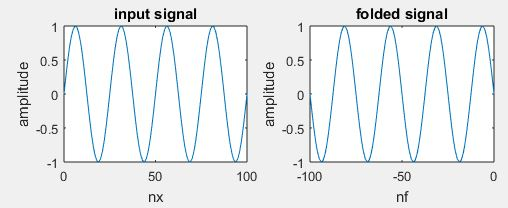
Time reversal of a signal x(t) is defined as folding of a signal at t=0,it is very useful in convolution.

Y(t)=y(-t)

clc;

close all;

clear all;

t=0:.01:1;

x1=sin(2*pi*4*t);

h=length(x1);

nx=0:h-1;

subplot(2,2,1);

plot(nx,x1);

xlabel(‘nx’);

ylabel(‘amplitude’);

title(‘input signal’)

y=fliplr(x1);

nf=-fliplr(nx);

subplot(2,2,2);

plot(nf,y);

xlabel(‘nf’);

ylabel(‘amplitude’);

title(‘folded signal’);

Addition:

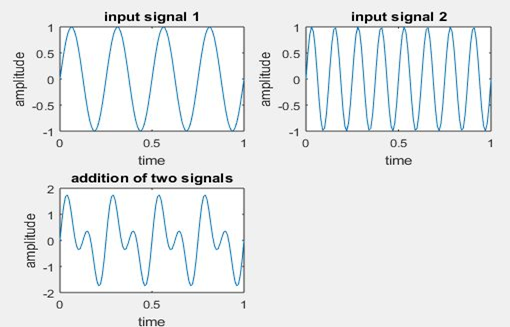
Addition of signal may be defined as adding of two continuous signals x1(t) and x2(t) at every time instant.

c(t) = x (t) + y (t)

clc;

close all;

clear all;

t=0:.01:1;

x1=sin(2*pi*4*t);

x2=sin(2*pi*8*t);

subplot(2,2,1);

plot(t,x1);

xlabel(‘time’);

ylabel(‘amplitude’);

title(‘input signal 1’);

subplot(2,2,2);

plot(t,x2);

xlabel(‘time’);

ylabel(‘amplitude’);

title(‘input signal 2’);

y1=x1+x2;

subplot(2,2,3);

plot(t,y1);

xlabel(‘time’);

ylabel(‘amplitude’);

title(‘addition of two signals’);

Multiplication:

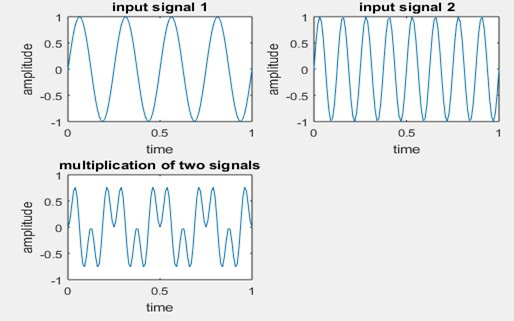
Multiplcation of signal may be defined as multiplying of two continuous signals x1(t) and x2(t) at every time instant.

C(t)=x(t) y(t)

clc;

close all;

clear all;

t=0:.01:1;

x1=sin(2*pi*4*t);

x2=sin(2*pi*8*t);

subplot(2,2,1);

plot(t,x1);

xlabel(‘time’);

ylabel(‘amplitude’);

title(‘input signal 1’);

subplot(2,2,2);

plot(t,x2);

xlabel(‘time’);

ylabel(‘amplitude’);

title(‘input signal 2’);

y2=x1.*x2;

subplot(2,2,3);

plot(t,y2);

xlabel(‘time’);

ylabel(‘amplitude’);

title(‘multiplication of two signals’);

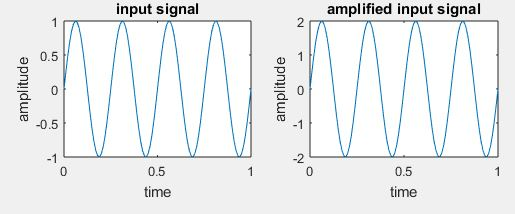
Scaling:

Scaling is defined as time expansion are compression of a given signal. Mathematically is represented as

Y(t)=x(at)

clc;

close all;

clear all;

t=0:.01:1;

x1=sin(2*pi*4*t);

A=2;

y=A*x1;

figure;

subplot(2,2,1);

plot(t,x1);

xlabel(‘time’);

ylabel(‘amplitude’);

title(‘input signal’)

subplot(2,2,2);

plot(t,y);

xlabel(‘time’);

ylabel(‘amplitude’);

title(‘amplified input signal’);

DATA FLOW

DATA FLOW:

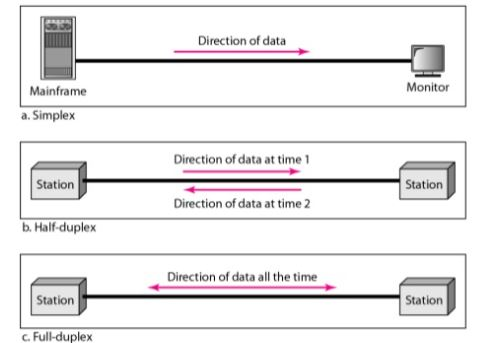
Data communication between two devices can be simplex, half-duplex and full-duplex

Simplex:

In simplex mode the data communication will take place in one direction or unidirectional, only one device can transmit and other device will only receive the data. Some of the example of simplex mode is keyboard and monitor, in these the keyboard will transmit and monitor will accept it.

Half-duplex:

Where in half-duplex mode one station can transmit and other receive it and vice versa. In these mode both devices can transmit and receive but not at the same time. Walkie-talkie is an example of half duple mode.

Full duplex:

In a full-duplex mode, both the station can transmit and receive at the same time. It looks like two- way traffic road which allows the traffic in both the directions. One of the most common examples in full-duplex is the telephone line.

Network:

Network may be a set of nodes connected by communication links. While a device may be a computer, printer or other devices which has the capability of sending and receiving data generated by other devices on the network.

Network must meet some important criteria which may include performance, reliability and security.

Performance:

Performance may be defined as measuring of transmit time and response time. Transmit time is defined as amount of time required for a message to travel from one device to another device. Response time will be defined as the elapsed time between an inquiry and a response.

Reliability:  

Accurately delivery of data is defined in terms of reliability which is measured from the frequency failures.

Security:

Security is defined as protecting data from unauthorized access and from damage. Security can be provided to a network by using some rules and procedures.

Types of connection:

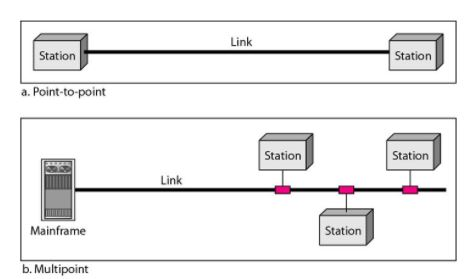
Network is defined as the combination of two or more devices connected via a physical path. A physical path is a link between two devices which transfer data from one device to another device. There are two types of connections. They are;

Point-to-point:

Point-to-point connection provides dedicated path between two devices, in these the entire capacity is reserved only between those two devices.

Multipoint:

Multipoint connection is defined as more than one device share a specific path, in this the entire path is shared temporarily are permanently between those devices.

Aperiodic signals

0

Aperiodic signals:

If the signal does not repeat at regular intervals of time is called aperiodic signal.

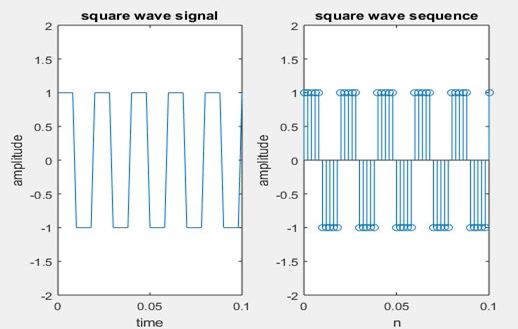
Square wave:

Let us consider an example for square wave in matlab.

clc;

clear all;

close all;

t=0:0.002:0.1;

y=square(2*pi*50*t);

figure;

subplot(1,2,1);

plot(t,y);

axis([0 0.1 -2 2]);

xlabel(‘time’);

ylabel(‘amplitude’);

title(‘square wave signal’);

%generation of square wave sequence

subplot(1,2,2);

stem(t,y);

axis([0 0.1 -2 2]);

xlabel(‘n’);

ylabel(‘amplitude’);

title(‘square wave sequence’);

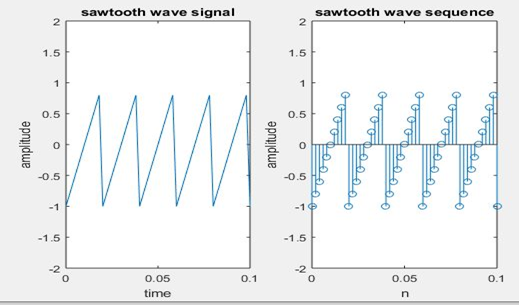
Sawtooth wave:

Let us consider an example of sawtooth wave in matlab.

clc;

clear all;

close all;

%generation of sawtooth signal

t=0:0.002:0.1;

y=sawtooth(2*pi*50*t);

subplot(1,2,1);

plot(t,y);

axis([0 0.1 -2 2]);

xlabel(‘time’);

ylabel(‘amplitude’);

title(‘sawtooth wave signal’);

%generation of sawtooth sequence

subplot(1,2,2);

stem(t,y);

axis([0 0.1 -2 2]);

xlabel(‘n’);

ylabel(‘amplitude’);

title(‘sawtooth wave sequence’);

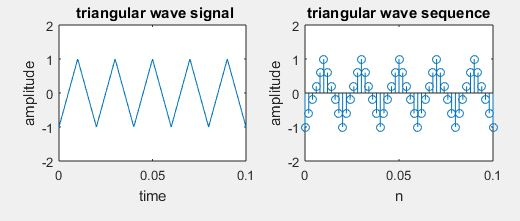
Triangular wave:

Let us consider an example of triangular wave in matlab.

clc;

clear all;

close all;

%generation of triangular wave signal

t=0:0.002:0.1;

y=sawtooth(2*pi*50*t,.5);

figure;

subplot(2,2,1);

plot(t,y);

axis([0 0.1 -2 2]);

xlabel(‘time’);

ylabel(‘amplitude’);

title(‘ triangular wave signal’);

%generation of triangular wave sequence

subplot(2,2,2);

stem(t,y);

axis([0 0.1 -2 2]);

xlabel(‘n’);

ylabel(‘amplitude’);

title(‘triangular wave sequence’);

DATA COMMUNICATION

DATA COMMUNICATION:

If one is communicating means sharing some relevant data these sharing can be local or remote. While sharing information face to face is called as local whereas sharing over some distance is called as remote. The term telecommunication may include telephone, telegraph etc., and communication means at a distance.

And the term data communication determines exchange of information between two devices by using some transmission medium.

Data communication depends upon some basic characteristics:

Delivery:

The term delivery means sending data to the intended destination.

Accuracy:

The system will delivered the data without altering the information to the destination.

Timelines:

Data must delivered to the end device with in a timely manner, if the data is delivered late it will be useless.

Jitter:

Jitter is defined as variation in the packet arrival time. For example if we send a video packet every 30ms. If it is arrive with the delay of 30ms it will result in uneven quality in the video.

Components in data communication:

There are five components in data communication:

Message:

The message is the data to be communicated. Most popular form of message which may include text, pictures, video, audio and numbers.

Sender:

Sender is the equipment that sends the message. Sender may include camera, telephone, computer and workstation and so on.

Receiver:

Receiver is the equipment that receives the information from medium, which may include camera, telephone, computer and workstation and so on.

Transmission medium or physical path:

In information is travelled form sender to receiver via some physical medium, some examples of transmission medium are radio waves, coaxial cables and twisted pair ,so on.

Protocol:

A protocol is defined as an agreement between communicating devices, without protocol the communication cannot be done connection of two devices may be done.

GENERATION OF SIGNALS AND SEQUENCES

0

GENERATION OF SIGNALS AND SEQUENCES:

If we defines amplitude of the signal at every instant of time is called continuous time signal, else if we define at some instant of time is called discrete time signal. If the signal repeats at regular intervals is called as periodic signal. Else it is called as aperiodic. Let us consider some example of periodic and aperiodic signals.

Periodic: ramp, sinc, unit step and ramp.

Aperiodic: sawtooth, square, triangular sinusoidal.

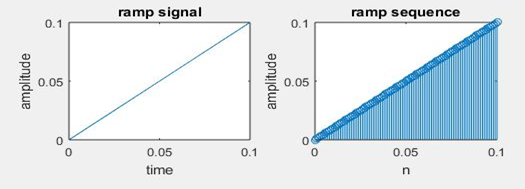
Ramp signal:

The ramp function is a singular real function.it is applied in engineering. Easily computable because of the mean of the experimental variable and its definite quantity. Ramp function is defined as:

               r(t)= t   when   t≥0

0 Otherwise

clc;

clear all;

close all;

t=0:0.001:0.1;

y1=t;

figure;

subplot(2,2,1);

plot(t,y1);

xlabel(‘time’);

ylabel(‘amplitude’);

title(‘ramp signal’);

%generation of ramp sequence

subplot(2,2,2);

stem(t,y1);

xlabel(‘n’);

ylabel(‘amplitude’);

title(‘ramp sequence’);

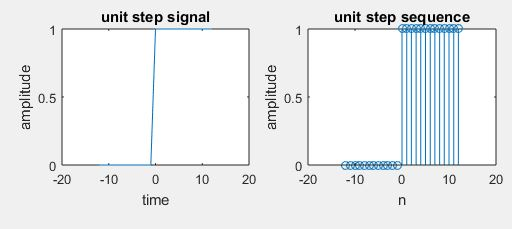
Unit step:

Unit step function is considered as a fundamental function in engineering and strongly recommended which the reader becomes very familiar.

u(t) =0 if t<0

         1 if t>0

          ½ if t=0

clc;

clear all;

close all;

t=-12:1:12;

y=(t>=0);

subplot(2,2,1);

plot(t,y);

xlabel(‘time’);

ylabel(‘amplitude’);

title(‘unit step signal’);

%generation of unit step sequence

subplot(2,2,2);

stem(t,y);

xlabel(‘n’);

ylabel(‘amplitude’);

title(‘unit step sequence’);

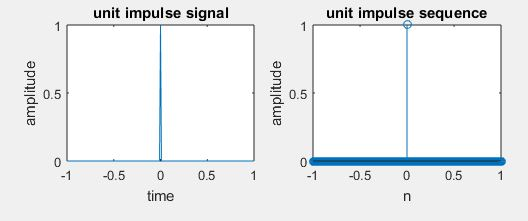
Unit impulse:

Unit impulse function is most useful function in study of linear system.

S(t) =1 when t=0

         0 otherwise

clc;

clear all;

close all;

%generation of unit impulse signal

t1=-1:0.01:1

y1=(t1==0);

subplot(2,2,1);

plot(t1,y1);

xlabel(‘time’);

ylabel(‘amplitude’);

title(‘unit impulse signal’);

%generation of impulse sequence

subplot(2,2,2);

stem(t1,y1);

xlabel(‘n’);

ylabel(‘amplitude’);

title(‘unit impulse sequence’);

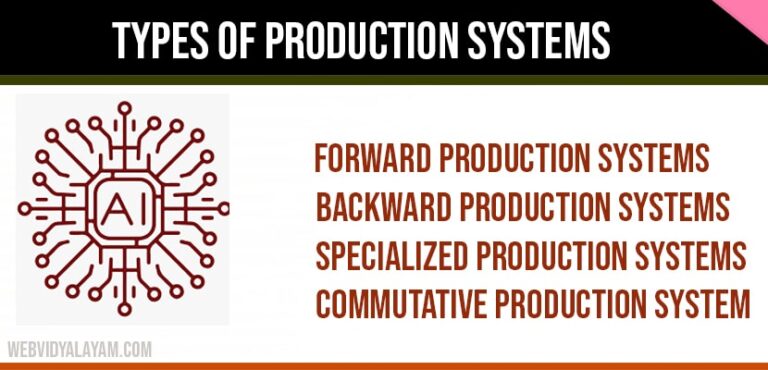
Types of Production Systems

 The following are the types of production systems.

Forward Production Systems:

  1. A Production system in which starting from an initial state moving towards the goal state is termed as Forward Production Systems.

Backward Production Systems:

  1. A Production system in which starting at goal state and tracing back towards initial state.

Specialized production systems:

 There are two types of Specialized Production systems they are

  1. Commutative production system
  2. Decomposable Production System

Commutative production system:

A production system is said to be commutative if it satisfies the following property

  1. Each member of set of rules applicable to D is also applicable to any database produced by applying an applicable rule to ‘D’
  2. If the goal condition is satisfied by ‘D’ then it is also satisfied by any data base produced by applying any applicable rule to ’D’.
  3. The database that results by applying to ‘D’ any sequence composed of rules that are application to D is invariant under permutations of the sequence.

Overall computation cost of AI Production System, Types of Control Strategy

Overall computation cost of AI Production System:

 Rule application cost and control strategy cost together constitutes to the over all computation cost of AI production system.

For an efficient AI system to design there must be balancing between the rule application cost and control strategy.

An efficient AI system involves the usage of the techniques that uses large amount of problem related information without acquiring excessive  control cost.

Types of Control Strategy

There are two types of control strategy they are

  1. Irrevocable
  2. Tentative
  3. Backtracking
  4. Graph Search Control

Irrevocable Strategy:

It is a type of control strategy in which once the rule is applied it cannot be retraced.

Here in this, the applicable rule is applied without any provision for reconsideration.

Tentative Strategy:

App rule is applied but provision is made to return later to this point in the computation to apply some other rule. Tentative strategy includes:

Backtracking:

 In this a point is established to which the state of communication can revert to this point.

 In this, there is a provision that  is made for monitoring the effects of several sequences of rules simultaneously.

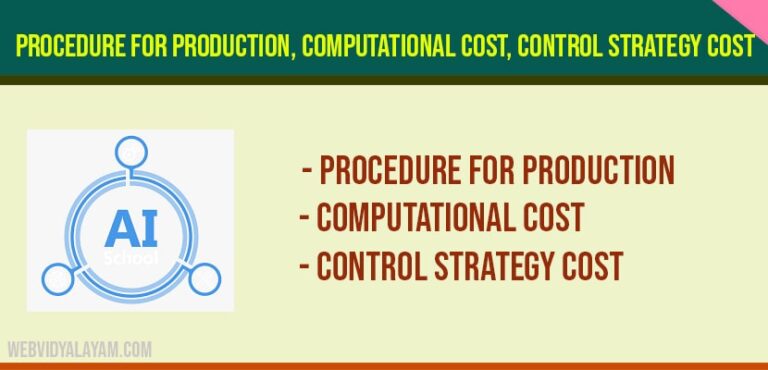
Procedure for production, Computational Cost, Control Strategy cost

Procedure for production

Initially we have a data base that has updated data and we continue to work with operators till we reach a goal condition.

We select  some  rule’ R’ from the set of rules applied to the data.

We apply that rule to generate new data.

We continually perform this until we reach the required condition.

If the required condition is achieved then we say that the problem is achieved.

Control Strategy 

Selecting the rules and keeping track of those sequence of rules and the database they produce constitute is termed as control strategy for production system.

Operations of AI production systems can be characterized as a search process in which rules are tried until some sequence of them is found that produces a database satisfying the termination condition.

Computational Cost

 Very important attribute for selecting rules is the amount of information that you aware of   about the problem.

In the worst case if I don’t know any thing about the problem the rule can be selected arbitrarily, as I don’t know anything about the problem.

 At the informed extreme , when I know the complete knowledge about the problem  the control strategy is guided by the problem knowledge and this  guidance is enough to select  a correct rule every time.

Overall computational cost of  a AI production system can be categorized into two  major categories.

Rule Application Cost:

For uninformed Control System:

In this system we have try a large number of rules to find a solution ,Therefore we have a high rule application cost.

For informed Control System:

In informed control system the production system is directly guided to the solution, Therefore very less Rule Application Cost

Control Strategy Cost:

For uninformed Control System:

Here in this case  arbitrary selection does not depend on costly computation. Therefore we have a low computational Cost.

For informed Control System:

To inform about the problem domain, cost in terms of storage and computation. Therefore we have a high control strategy computation.