Saturday, May 2, 2026
Home Blog Page 6

AND-OR Graph

0

Nodes labeled by component databases have sets of successor nodes each labeled by one of the components. These nodes are called AND nodes because in order to process the compound database to termination all of the component database must be processed to termination. so this node here in order to process C B Z to termination, C,B and Z needs to be processed to termination. In order  to process BM to termination both B and M needs to be processed to termination; so  on and so forth. Another important  thing that one needs to realize is that the successor nodes labeled by the result of rule application. Like here when I have D and L or I have B and M as  I applied rule onto C .They are referred to as the ‘OR’ nodes. Because , in order to process a component database to termination , the database resulting from only either this or this must be processed to termination. These are referred to as ‘OR’ nodes The structure called AND-OR graphs  are useful for depicting the activity of production systems. So these are the nodes , these are the or nodes. So the decomposable production system if you see these nodes that I have marked now as AND here are important because if a component database is ; all of the component databases need to be moved to termination. So, that is the and node here .That is the and node. This is the and node. Both  of them needs to be moved to the termination. So, finally we can say that the notion of decomposable production system encompass a technique often called problem Reduction in AI. We have reduced the problem  of taking C B Z to termination. To the problem of taking C, B and Z individually to termination.

Goal of decomposable production system

Problem Reduction idea usually involves replacing a problem goal by a set of   sub goals such that if the sub goals are solved, the main goal is also solved.

Explaining problems in terms of decomposable production system allows us to be indefinite about whether we are decomposing problem goals or problem states.

Variables in python

0


What is a variable?


• A variable refers to memory location.
• It is used to store the value .
• Variable is used to give data to the computer for processing .
Specifying a variable
• In python we don’t need to specify the type of variable because python isa dynamically typed to get variable type.
• Variable names include letters and digits but they have to begin with a letter or an underscore.
• It is suggested to use lowercase letters for variable name.


Types of variables


There are two types of variables in python local and global variables.
• In Python, global variable is a variable declared outside of the function or in global scope.
• global variable can be accessed inside or outside of the scope function
Local variables
Local variables are the variables that are used with in a function or method.
Global variables
Global variables are used when we use the variable in the entire program.
Assigning values to variables
• Python allows us to assign values to the variables.
• Lets assume the value 5 is assigned to the variable ‘a’

Multiple assignment
• in multiple assignment , multiple variables are assigned with multiple values.
Example

Declaring and re-declaring the variables.
• Lets first see how to declare a variable. Its that simple that assigning variable a value to hold.
• Example

a=9
print(a)
9
• Now we re declare the variable.
• a=9
print(a)
a= 33
print(a)
output:
33
Here the output gives the re assigned value instead of first value. This means that the firstvalue is replaced by second value.
Deleting the variable
• In python you can delete the variable that you previously assigned the value using del command.
Example
a=7
print(a)
del a
print(a)

Introduction to cellular concept

0

Cellular Concept:

  • Cellular concept deals with reduction of service area by employing high power transmitters that offer high capacity in a limited spectrum allocation.
  • In a geographic region, each base station is assigned with different group of channels from the total number of channels available to the entire system.
  • This distribution cochannels reduce the interference between the base stations and mobile users under their control.
  • The channels can be reused until the interference between cochannel stations is at acceptable level.
  • The number of base stations increase with increase in demand for service, hence, providing additional radio capacity within the radio spectrum.
  • Cellular concept is responsible for manufacturing every piece of user equipment of large area such that any mobile can be accessed within the range.

Advantages of cellular system:

  • Problem of spectral congestion  is solved by cellular system.
  • It offers high capacity with limited spectrum.
  • This high capacity is achieved by limiting the coverage area of each base station to a small geographic area termed as cell.
  • In cellular system each high power transmitter is replaced with several low power transmitters.
  • Each base station is allocated a  portion of channels and nearby cells are allocated completely different channels.
  • All available channels are allocated to small number of  base stations.

Introduction to CellularConce

0

Cellular Concept:

  • Cellular concept deals with reduction of service area by employing high power transmitters that offer high capacity in a limited spectrum allocation.
  • In a geographic region, each base station is assigned with different group of channels from the total number of channels available to the entire system.
  • This distribution cochannels reduce the interference between the base stations and mobile users under their control.
  • The channels can be reused until the interference between cochannel stations is at acceptable level.
  • The number of base stations increase with increase in demand for service, hence, providing additional radio capacity within the radio spectrum.
  • Cellular concept is responsible for manufacturing every piece of user equipment of large area such that any mobile can be accessed within the range.

Advantages of cellular system:

  • Problem of spectral congestion  is solved by cellular system.
  • It offers high capacity with limited spectrum.
  • This high capacity is achieved by limiting the coverage area of each base station to a small geographic area termed as cell.
  • In cellular system each high power transmitter is replaced with several low power transmitters.
  • Each base station is allocated a  portion of channels and nearby cells are allocated completely different channels.
  • All available channels are allocated to small number of  base stations.

How to Enable Debug Mode in WordPress

0
  • To Enable Debug Mode in WordPress -> Open wp-config file in your root folder -> define( ‘WP_DEBUG’, true ); and save wp-config file.

If you are having issue with your wordpress website and wordpress is showing blank page or white screen of death on wordpress is responding in an unexpected way and you dont know whats happening with your wordpress website as everything seems to be working fine and well connected with database in wp-config file and no issues with htaccess redirects as well then you need to enable debug mode in wordpress in wp-config.php file and rectify the error in wordpress.

Note: Enabling debug mode will display all errors in the front end and warnings and notices as well on your front end website. (which will be seen by users as well). You need to check with the errors and disable debug mode on wordpress once you fix errors.

How to enable Debug Mode in WordPress

Make these below changes in your wordpress wp-config file and it will enable debug mode.

Step 1: Go to your root website folder on your wordpress

Step 2: Now, locate wp-config.php file

Step 3: Open it with your favorite editor (sublime or notepad or any other editor).

Step 4: In wp-config.php file place this code -> define( ‘WP_DEBUG’, true ); and save  and close wp-config file.

That’s it, this is how you enable   debug mode in wordpress website and fix errors on wordpress.

Enable Debug Mode on WordPress -GoDaddy

The process is pretty simple and all you need to do is define wp_debug to true to enable debug mode on wordpress -godaddy.

Before making any changes to wp-config file, it’s recommended to take a backup of your wp-config file and if anything goes wrong you can replace it with the previous version of wp-config file.

Step 1: Login to your go daddy account and navigate to my products

Step 2: Go to cPanel -> Locate file manager and click on it which will open the folder structure of your website.

Step 3: Now, take a backup of the wordpress website or wp-config.php file to your computer.

Step 4: Now, click on wp-config.php file and click on edit

Step 5: At the bottom of wp-config.php file -> define( ‘WP_DEBUG’, true ); and save wp-config file.

That’s it, this is how you enable debug mode on wordpress godaddy website.

AMPS operation

AMPS operation:

A simple diagram of how AMPS system handles various calls and other responsibilities as shown in below diagram. As the power up, all mobile station is in the range of a base station which go through a registration with AMPS before actual service starts. According to the state of the system, the incoming and outgoing calls are handled. When handoff has occurred to the adjacent cells mobile station will undergo the registration process.

To perform various functions in AMPS three identification numbers are required they are:

Electronic serial number (ESN):

A 32-bit binary number uniquely identifies a cellular unit or mobile station and established by the manufacturer at the factory. Therefore it is unique, any mobile station will be identified by using this number. For some security reasons, this number should not be alterable and should be present in all mobile stations.

System identification number (SID):

A 15-bit unique binary number assigned to a cellular system. Every cellular system is assigned with a system identification number which is used by all mobile stations registered in the service area this number is given by the Federal communication commission (FCC). This number is given to the mobile station for transmitting data which handles the calls. The SID serves as a check and can be used in determining if a particular mobile station is registered in the same system.

Mobile identification number (MIN):

Where the particular location of the mobile station is not predictable. With this, a question arises how a mobile station knows when it receives a call. The answer for this is the message passed on the control channels. Whenever the mobile station is not in service, it tunes to the strongest channel to find out useful control information. The same happens at the base station as well. There are two important control channels: reverse control channels (ROCC from base station to mobile station, and forward control channels from mobile station to base station both are operating at 10kbps (FOCC).

Interpolation Process Implementation and I/D sampling rate convertor implementation

Interpolation Process Implementation:

Theory:

“Upsampling” is defined as the process of inserting zero-valued samples between original samples to increase the sampling rate. (This is called “zero-stuffing”.) . “Interpolation”, is determined as the process of upsampling followed by filtering. The filtering removes the undesired spectral images. The main reason for interpolating is simply used to maximize the sampling rate at the output of a particular system so that another system operating at a better rate can input the signal.

Steps to perform interpolation process:

Step I: Let’s define up sampling factor and input frequencies f1 and f2

Step II: Now represents the input sequence with frequencies f1 and f2

Step III: In order to perform the interpolation on input signal by using the matlab command interp.

Step IV: Next to plot the input and output signal/sequence.

Program:

clc;

clear all;

close all;

L=input(‘enter the upsampling factor’);

N=input(‘enter the length of the input signal’); % its Length should be always greater than 8

f1=input(‘enter the frequency of first sinusoidal’);

f2=input(‘enter the frequency of second sinusoidal’);

n=0:N-1;

x=sin(2*pi*f1*n)+sin(2*pi*f2*n);

y=interp(x,L);

subplot(2,1,1)

stem(n,x(1:N))

title(‘input sequence’);

xlabel(‘time(n)’);

ylabel(‘amplitude’);

subplot(2,1,2)

m=0:N*L-1;

stem(m,y(1:N*L))

title(‘output sequence ‘);

xlabel(‘time(n)’);

ylabel(‘amplitude’);

Output:

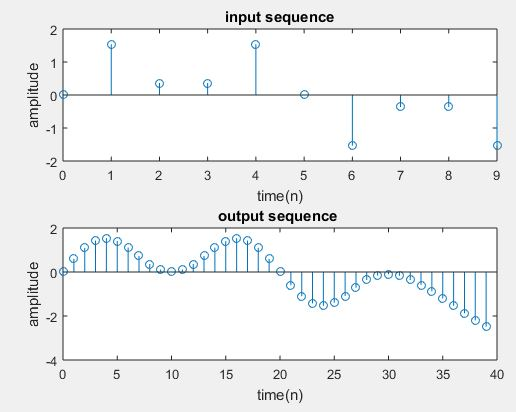
enter the upsampling factor4

enter the length of the input signal10

enter the frequency of first sinusodal0.1

enter the frequency of second sinusodal0.3

I/D sampling rate convertor implementation:

Steps to perform the I/D sampling rate conversion:

Step I: Let’s define the upsampling factor, downsampling, and input frequencies f1 and

 f2

Step II: Let’s represent the input sequence with frequencies f1 and f2

Step III:  In order to perform I/D sampling rate conversion on the given input signal by using Matlab resample.

Step IV: To plot the input and output signal/sequence.

Program:

clc;

clear all;

close all;

L=input(‘enter the upsampling factor’);

D=input(‘enter the downsampling factor’);

N=input(‘enter the length of the input signal’);

f1=input(‘enter the frequency of first sinusoidal’);

f2=input(‘enter the frequency of second sinusoidal’);

n=0:N-1;

x=sin(2*pi*f1*n)+sin(2*pi*f2*n);

y=resample(x,L,D);

subplot(2,1,1)

stem(n,x(1:N))

title(‘input sequence’);

xlabel(‘time(n)’);

ylabel(‘amplitude’);

subplot(2,1,2)

m=0:N*L/D-1;

stem(m,y(1:N*L/D));

title(‘output sequence ‘);

xlabel(‘time(n)’);

ylabel(‘amplitude’);

output:

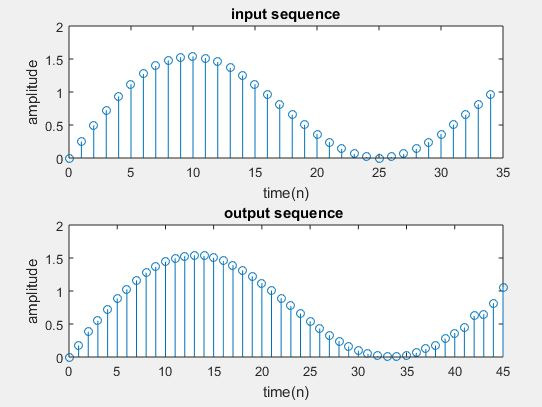
enter the upsampling factor4

enter the downsampling factor3

enter the length of the input signal35

enter the frequency of first sinusodal0.01

enter the frequency of second sinusodal0.03

Introduction of advanced mobile phone system (AMPS)

Introduction to some existing wireless systems:

For wireless system we consider many factors as its needs such as call duration, traffic in adjacent cell, call rate, atmosphere condition and the terrain. Various characteristics are important to get an idea about how wireless system will work in the real-world for the existing cellular system and how it support the mobile communication. In order to emphasis the communication between the sender and the receiver it should follow some set of rules called communication protocols. For facilitating easy transfer of information there are some steps for open system interconnection (OSI) and international organization for standardization (ISO).

Introduction of advanced mobile phone system (AMPS):

AMPS is the first cellular system used in United States. It uses FM modulation technique for transmitting speech signal, one of the important property is control information was transmitted in digital form using FSK. Which is created by AT&T Bell Labs with the key idea of splitting the entire service area into logical division is called cell. And the divided cell is allocated with specific band from the frequency spectrum.

While AMPS uses the cell radius upto 1 to 16 miles, depending on different factors such as traffic density and density of users. Smaller cells have less thermal noise and more interference and larger cells have more thermal noise and less interference. One of the most important consideration of AMPS is it allows both cell sectoring and splitting.

Some characteristics of AMPS:

The frequency band used in AMPS between 824 MHz to 849 MHz for transmission from reverse link and the frequency band used in the forward link is 869 MHz to 894 MHz.  Manchester frequency modulation is used for transmitting data at the rate of the 10kbps, while the control parameters remains the same as in voice transfer.

For transmitting control information and data separate channels are used some control messages are exchanged between the mobile station and the base station has compared with data or voice messages, a smaller number of control channels are employed than voice antennas.

In AMPS the frequency allocation is done by splitting the entire frequency spectrum into two bands B and B and B and A.

Decimation process implementation

Decimation process implementation:

Theory:

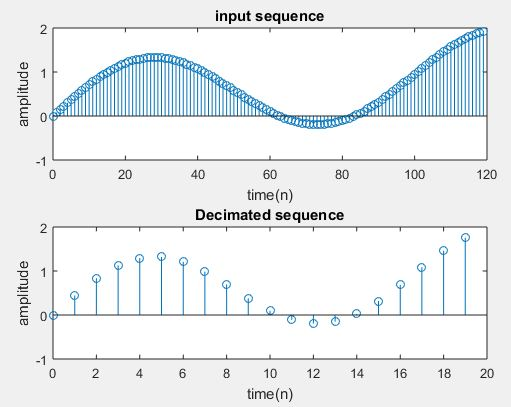
“Decimation” is that the process of reducing the rate.

“Down sampling” may be a more specific term that refers to only the method of throwing away samples, without the low pass filtering operation. The most important reason to decimate is simply to reduce the sampling rate at the output of 1 system so a system operating at a lower rate can input the signal. But the away more common motivation for decimation is to scale back the value of processing: the calculation and the memory required to implement a DSP system generally is proportional to the rate, therefore the use of a lower rate usually leads to a cheaper implementation.

Steps involved in performing decimation process:

Step I: let’s define down sampling factor and input frequencies f1 and f2

Step II: And Represent input sequence with frequencies f1 and f2

Step III: To perform the decimation on input signal by using MatLab command decimate.

Step IV: Next plot the input and output sequence.

Program:

clc;

clear all;

close all;

D=input(‘enter the down sampling factor’);

L=input(‘enter the length of the input signal’);

f1=input(‘enter the frequency of first sinusoidal’);

f2=input(‘enter the frequency of second sinusoidal’);

n=0:L-1;

x=sin(2*pi*f1*n)+sin(2*pi*f2*n);

y=decimate(x,D,’fir’);

subplot(2,1,1);

stem(n,x(1:L));

title(‘input sequence’);

xlabel(‘time(n)’);

ylabel(‘amplitude’);

subplot(2,1,2)

m=0:(L/D)-1;

stem(m,y(1:L/D));

title(‘Decimated sequence’);

xlabel(‘time(n)’);

ylabel(‘amplitude’);

Output:

enter the down sampling factor6

enter the length of the input signal120

enter the frequency of first sinusodal0.002

enter the frequency of second sinusodal0.01

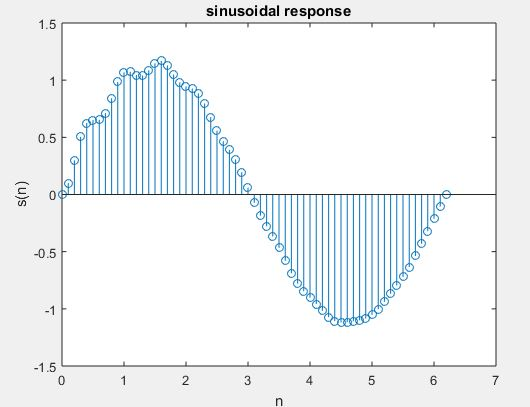
SINUSOIDAL SIGNAL GENERATION THROUGH FILTERING PROCESS:

One of the most important applications of an LTI discrete-time system is to pass certain frequency components in an input sequence with no distortion and block other frequency components. Such systems are called digital filters. The key to the filtering process is the inverse Discrete Fourier transform, which expresses an arbitrary input sequence as a the linear weighted sum of an infinite number of exponential sequences, or equivalently, as a the linear weighted sum of sinusoidal sequences. As a result, by appropriately choosing the values of magnitude function of the LTI digital filter at frequencies like the frequencies of the sinusoidal components of the input, a number of these sinusoidal sequences can be selectively heavily attenuated or filtered with reference to the others.

Program:

close all;

clear all;

clc;

b=[1];

a=[1,-1,0.9];

 n=[-20:120];

 t=0:0.1:2*pi;

 x=sin(t);

 s=filter(b,a,x);

 stem(t,s);

 title(‘sinusoidal response’);

 xlabel(‘n’);

 ylabel(‘s(n)’);

Connections in cellular telephone system:

The three subsystems of the cellular system are connected using high speed data links.

The mobile unit and cell site are connected through radio link that conveys the voice and signaling information between them.

The channel used by each mobile unit for communication is not fixed, the channel can be any one in the complete bandwidth allocated by the serving area .But only a single channel is used at a time to convey information between two entities.

                A standard Common Air Interface (CAI)carries out the communication between the mobile and  base-station or cell unit with the help of four different channels. They are :

  1. Forward Voice Channels:

This channel is used to transmit the voice signal to mobile from cell unit.

2. Reverse Voice Channels:

This channel transmits the voice channels from mobile unit to base station.

3. Forward Control Channels:

This channel initiates the cells at base station. As this channel continuously broadcasts all of the traffic requests of all the mobiles in the system, it can also be used as beacons.

4. Reverse Control Channel  :

This channel initiates the calls at mobile unit.

The control channels only deal with the setting up of a call and transferring it to the vacant channel. Hence , these are also called as setup channels.

These channels transmit and receive the  data that uphold call setup and service requests. When there is no call in progress, mobile unit handles the channels.