Saturday, May 2, 2026
Home Blog Page 7

Working of cellular telephone system

Cellular Telephone System

  Cellular system  accommodate a large number of users over a large geographic area, within a limited frequency spectrum and provide high quality service that is often comparable to that of the land line telephone system.

 High capacity is achieved by limiting the coverage area of each base station transmitter to a small geographic area called ‘cell’ so that  another base station reuses the  same radio channels  located some distance away.

 A sophisticated switching called a handoff enables a call to proceed uninterrupted, when the user moves from one cell to another.  A wireless connection  is provided by the system  to the PSTN for any user location within the radio range of the system.

Working of Cellular telephone system

Cellular Telephone system consists of three sub-systems they are

1.            Mobile unit

2.            Cell site

3.            Mobile Telephone Switching Office

All these three sub-stations are joined using high-speed data links.

Mobile unit:

This subsystem encompasses a control unit, a transceiver to transmit an receive signals and an antenna to radiate signals.

Cell Site:

This part of the cellular system  acts as an interface between mobile telephone switching center and the mobile unit. It encompasses all the elements of a mobile unit  in addition, it has radio cabinets , power plant and data terminals.  

Mobile Telephone Switching Office:

The MTSO is the most important cooperating element for all cell sites in the cellular system. It has a cellular processor and cellular switch The switching office is linked to telephone company zone offices and its main function is to control call processing and manage billing activities. The cellular switch is used to connect one mobile subscriber to another mobile subscriber in the cellular mobile system. The voice trunks used by MTSO are similar to voice trunks used by telephone company zone offices. In addition, it has data links that imparts administration links between the processor and the cell sites and between processor and switch.
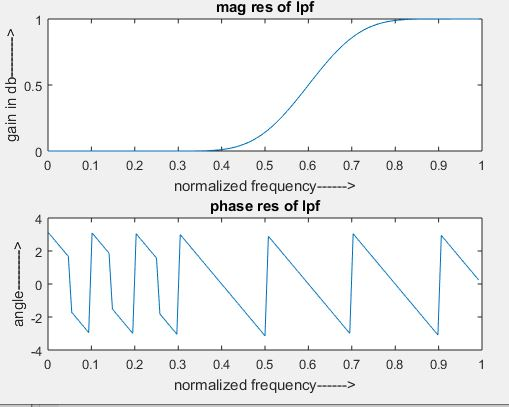
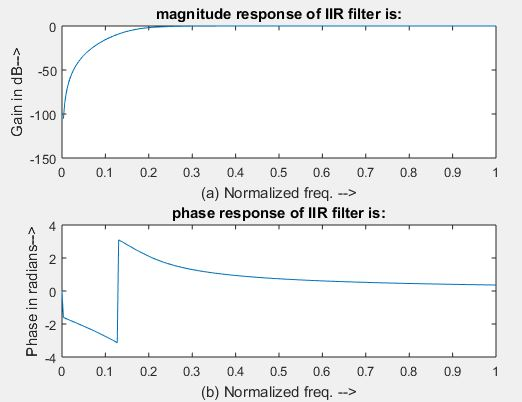
High pass FIR filter implementation and High pass IIR filter implementation

Steps involved in performing FIR filter operation

Step I: Let’s enter the pass band frequency (fp) and stop band frequency (fq).

Step II: And then get the sampling frequency (fs), length of window (n).

Step III: Next calculate cut off frequency.

Step IV: Use the boxcar, hamming, Blackman Commands for designing window.

Step V: And then design filter by using above parameters.

Step VI: To find frequency response of the filter by using matlab command freqz.

Step VII: Then plot the magnitude response and phase response of the filter.

Program:

clc;

clear all;

close all;

n=20;

fp=300;

fq=200;

fs=1000;

fn=2*fp/fs;

window=blackman(n+1);

b=fir1(n,fn,’high’,window);

[H W]=freqz(b,1,128);

subplot(2,1,1);

plot(W/pi,abs(H));

title(‘mag res of lpf’);

ylabel(‘gain in db——–>’);

xlabel(‘normalized frequency——>’);

subplot(2,1,2);

plot(W/pi,angle(H));

title(‘phase res of lpf’);

ylabel(‘angle——–>’);

xlabel(‘normalized frequency——>’);

Steps involved in performing IIR filter operation

Step I: Now enter the pass band ripple (rp) and stop band ripple (rs).

Step II: while the pass band frequency (wp) and stop band frequency (ws).

Step III: Then Get the sampling frequency (fs).

Step IV: Then calculate the normalized pass band frequency, and normalized stop band frequency w1 and w2 respectively.

Step V : Make using the following function for calculating the Butterworth filter order [n,wn]=buttord(w1,w2,rp,rs ) and Chebyshev filter order [n,wn]=cheb1ord(w1,w2,rp,rs)

 Step VI: Let’s design the nth order digital high pass Chebyshev or Butterworth filter using the following commands. Butterworth filter [b,a]=butter (n, wn,’high’) Chebyshev filter [b,a]=cheby1 (n, 0.5, wn,’high’)

Step VII: In order to find the digital frequency response of the filter by using ‘freqz ( )’ function

Step VIII: Then calculate the magnitude for the frequency response in decibels (dB) mag=20*log10 (abs (H))

Step IX: Then plot the magnitude response [magnitude in dB Vs normalized frequency]

Step X: Next calculate the phase response using angle (H).

Step XI: Then plot the phase response [phase in radians Vs normalized frequency (Hz)].

Program:

clc;

clear all;

close all;

disp(‘enter the IIR filter design specifications’);

rp=input(‘enter the passband ripple’);

rs=input(‘enter the stopband ripple’);

wp=input(‘enter the passband freq’);

ws=input(‘enter the stopband freq’);

fs=input(‘enter the sampling freq’);

w1=2*wp/fs;w2=2*ws/fs;

[n,wn]=buttord(w1,w2,rp,rs,’s’);

disp(‘Frequency response of IIR HPF is:’);

[b,a]=butter(n,wn,’high’,’s’);

w=0:.01:pi;

[h,om]=freqs(b,a,w);

m=20*log10(abs(h));

an=angle(h);

figure, subplot(2,1,1);plot(om/pi,m);

title(‘magnitude response of IIR filter is:’);

xlabel(‘(a) Normalized freq. –>’);

ylabel(‘Gain in dB–>’);

subplot(2,1,2);plot(om/pi,an);

title(‘phase response of IIR filter is:’);

xlabel(‘(b) Normalized freq. –>’);

ylabel(‘Phase in radians–>’);

CELL CAPACITY

Cell traffic load is typically characterised has the two important distributed parameters.

  1. Average number of mobile stations requesting the service (average call arrival rate (λ).
  2. Average length of time the mobile stations requiring the service (average holding time T).

The offered traffic load is defined as                                        

a= λT.

For example, in a cell with 100ms, on average, if 30 requests are generated during an hour with an average holding time of T=360 seconds then the average call arrival rate is.     

λ =

A servicing channel that is kept busy in an hour is quantitatively defined as one ERLANG.

Here the traffic load offered for the example by ERLANG is        


             = 3 Erlang.

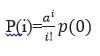
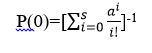
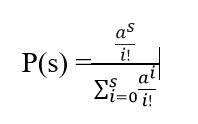
The average arrival rate is λ and the average departure rate is µ. Therefore all the channels are busy, for this arriving call is turned away. An M/M/S/S queuing model of the system can be analyzed. Since M/M/S/S is a special case of M/M/S/∞, steady-state probabilities p(i) for these systems have the same form as those for states i=0…S in the M/M/S/∞ model. Therefore, S is defined as the channels in a cell. Thus we have

 Where a= λ/µ is the offered load and

Therefore the arriving call probability p(s) blocked is equal to the probability of all the channels are busy, which is                                    

The above equation is called the Erlang B formula and is denoted by B(s, a). B(s, a). Therefore it also called blocking probability of rejection, or probability of loss.

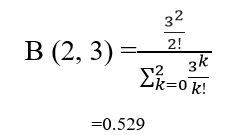
From the old example, if S is given as 2 with a=3, the blocking probability is

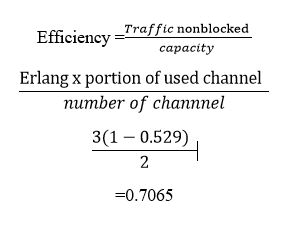
Therefore, a fraction of 0.529 calls is blocked, and that we got to reinitiate the decision. Thus the entire number of blocked calls is about 30*0.529=15.87. The efficiency of the system is often given by.

Evolution of mobile radio communication

  • The evolution of mobile radio communication throughout the world is beneficial. This is because it helps to understand the vast influence  of cellular radio and personal communication services over the next future decades. It helps to understand the variation in the evolution of wireless systems, services and technologies due to government regulatory agencies and service competitors. The progressive involvement of technology leads to growth and penetration of mobile market due to high cost and drastic changes in the technology. Wireless communication systems have been accepted by the subscribers at the rates comparable to the television and video cassette recorders.
  • Developments in mobile communications have been carried out slowly and then technical enhancements have been done. The wireless communication features were facilitated to entire public after the introduction of cellular concept by Bell laboratories in 1960’s and 1970’s.The future growth of mobile communication system depends on the allocation of radio spectrum advancement in technologies and regular decisions.
  • In the year1934, Amplitude Modulation (AM) mobile communication systems were utilized by 194 municipal police radio systems and 58 state police stations. The purpose of AM systems is to provide security for public in US. In the middle of 1930’s nearly 5000 radios were installed in mobiles , the users of which  suffered from vehicle ignition noise.
  • In the year 1935,FM was introduced by Edwin Armstrong in mobile communication system, which was then used as basic modulation technique in the world. Table below illustrates the growth and penetration of US mobile users.
YearGrowth in  US mobile users
1940Several thousand
194886,000
19586,95,000
19621.4 Million
198425,000
199012 Million
199125-40 Million
199325 Million
1995100 Million
2001630 Million
21 st century1 Billion

Advantages of Cellular systems over conventional mobile systems

Conventional  mobile SystemsCellular  mobile system
Spectrum utilization is inefficient in conventional mobile system since each channel serves only  one customer at a time.The cellular system improves efficiency by three approaches The allocated frequency band is divided  into maximum number off channels The allocated frequency band is reused in different  geographic  locations.Using Spread spectrum or frequency hopped technique, many codes are generated over a wide frequency band.  
Conventional mobile telephone systems use single carrier frequency  leading to half duplex .i.e., one way communication.Cellular mobile phones provides full duplex  i.e., two way communication
Conventional Mobile systems use a high power transmitters to cover large areasCellular mobile system uses low power transmitters to cover the same area.
Conventional mobile systems experiences the problem like spectral congestion and user capacity.Cellular system solves this problem by providing high user capacity relatively  within the limited spectrum of frequency.
Conventional systems are not widely used due to its high cost and limited availability.Cellular systems offer more availability and low cost.
Conventional systems cover only a smaller area.  Cellular systems cover large area.
In conventional system, the  capacity is increased by increasing RF.In mobile system, the mobile unit capacity is maximized without increasing RF.
Conventional systems do not maintain privacy.Cellular systems maintain privacy.

Introduction to Cellular Concept

Cellular Concept:

  • Cellular concept deals with reduction of service area by employing high power transmitters that offer high capacity in a limited spectrum allocation.
  • In a geographic region, each base station is assigned with different group of channels from the total number of channels available to the entire system.
  • This distribution cochannels reduce the interference between the base stations and mobile users under their control.
  • The channels can be reused until the interference between cochannel stations is at acceptable level.
  • The number of base stations increase with increase in demand for service, hence, providing additional radio capacity within the radio spectrum.
  • Cellular concept is responsible for manufacturing every piece of user equipment of large area such that any mobile can be accessed within the range.

Advantages of cellular system:

  • Problem of spectral congestion  is solved by cellular system.
  • It offers high capacity with limited spectrum.
  • This high capacity is achieved by limiting the coverage area of each base station to a small geographic area termed as cell.
  • In cellular system each high power transmitter is replaced with several low power transmitters.
  • Each base station is allocated a  portion of channels and nearby cells are allocated completely different channels.
  • All available channels are allocated to small number of  base stations.

Cell parameters and signal strength

The cellular system depends on the radio signal received by a mobile station throughout the cell and on the contours of signal strength emanating from the base station of two adjacent cells j and i.

As from the above discussion, the signal strength goes down as moves away from the base station. The difference in received power is a function of distance. Whereas the mobile station moves away from the base station of the cell, the signal strength weakness, and at some point, a phenomenon known as handoff occurs. This implies a radio connection to another adjacent cell. j

As the mobile station moves away from j cell and gets closer to the cell i. assuming that pj(x) and pi(y) represents the power received at the mobile station from the BSj and BSi, the received signal strength at the mobile station can be represented by curves and the variation can be expressed by the empirical relations. While the distance X1 from the received signal of  BSj is approximately close to zero and the signal strength at the mobile station can be primarily attributed to BSi. While, at distance X2, the signal from BSi is minor. To receive and interpret the signals correctly at the mobile station, the received signal must be at a given minimum power level pmin and the distance X3 and X4 have two such points for BSj and BSi, respectively.

Therefore that, between points X3 and X4, the mobile station is going to be served by either BSj and BSi, and therefore the choice is left to the service provider and the underlying technology. where the mobile station have a radio link with BSj and continuously moving towards away BSi then at some point it has to be connected to the BSi and the change of such linkage from BSj to BSi is known as a handoff. Therefore regions X3 and X4 indicate the handoff area.

Where the performs handoff depends on many factors.One of the considerations is that the handoff should not take place too quickly to make the MS change the BS too frequently. If the Mobile station moves forth and back between the overlapped area of two adjacent cells due to underlying terrain or intentional movements.

DTMF SIGNAL GENERATION

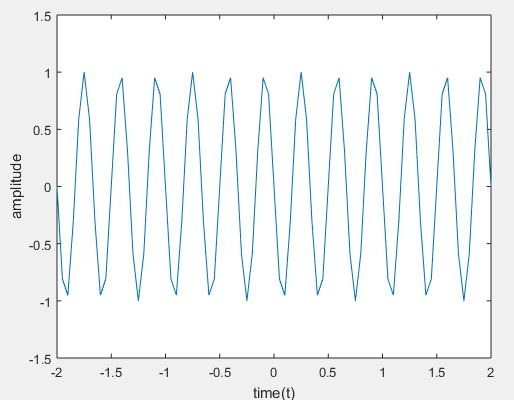
The DTMF stands for “Dual Tone Multi-Frequency”, and maybe a method of representing digits with tone frequencies, so as to transmit them over an analog communications network, for instance, a telephone line. In telephone networks, DTMF signals are wont to encode dial trains and other information. Dual-tone Multi-Frequency (DTMF) signaling is widely used for voice communications control and is mostly used worldwide in modern telephony to configure switchboards and to dial numbers. It is also utilized in systems like voice mail, electronic message, and telephone banking. The DTMF signal is considered as the sum of two sinusoids – or tones – with frequencies taken from two mutually exclusive groups. Where these frequencies are chosen to stop any harmonics from being incorrectly detected by the receiver as another DTMF frequency. while each pair of tones consist of one set frequency of the low group (697 Hz, 770 Hz, 852 Hz, 941 Hz) and another set frequency of the high group ( 1336 Hz, 1477Hz,1209 Hz) and represents a unique symbol.

Program:

clc;

clear all;

close all;

t = -2:0.05:2;

x=input(‘enter the input number’);

fr1=697;

fr2=770;

fr3=852;

fr4=941;

fc1=1209;

fc2=1336;

fc3=1477;

fc4=1633;

y0 = sin(2*pi*fr4*t) + sin(2*pi*fc2*t); % 0

y1 = sin(2*pi*fr1*t) + sin(2*pi*fc1*t); % 1

y2 = sin(2*pi*fr1*t) + sin(2*pi*fc2*t); % 2

y3 = sin(2*pi*fr1*t) + sin(2*pi*fc3*t); % 3

y4 = sin(2*pi*fr2*t) + sin(2*pi*fc1*t); % 4

y5 = sin(2*pi*fr2*t) + sin(2*pi*fc2*t); % 5

y6 = sin(2*pi*fr2*t) + sin(2*pi*fc3*t); % 6

y7 = sin(2*pi*fr3*t) + sin(2*pi*fc1*t); % 7

y8 = sin(2*pi*fr3*t) + sin(2*pi*fc2*t); % 8

y9 = sin(2*pi*fr3*t) + sin(2*pi*fc3*t); % 9

y_start = sin(2*pi*fr4*t) + sin(2*pi*fc1*t); % *

y_canc = sin(2*pi*fr4*t) + sin(2*pi*fc3*t); % #

if (x==1)

 plot(t,y1)

 xlabel(‘time(t)’)

 ylabel(‘amplitude’)

elseif (x==2)

 plot(t,y2)

 xlabel(‘time(t)’)

 ylabel(‘amplitude’)

elseif (x==3)

 plot(t,y3)

 xlabel(‘time(t)’)

 ylabel(‘amplitude’)

elseif (x==4)

 plot(t,y4)

 xlabel(‘time(t)’)

 ylabel(‘amplitude’)

elseif (x==5)

 plot(t,y5)

 xlabel(‘time(t)’)

 ylabel(‘amplitude’)

elseif (x==6)

 plot(t,y6)

 xlabel(‘time(t)’)

 ylabel(‘amplitude’)

elseif (x==7)

 plot(t,y7)

 xlabel(‘time(t)’)

 ylabel(‘amplitude’)

elseif (x==8)

 plot(t,y8)

 xlabel(‘time(t)’)

 ylabel(‘amplitude’)

elseif (x==9)

 plot(t,y9)

 xlabel(‘time(t)’)

 ylabel(‘amplitude’)

elseif (x==0)

 plot(t,y0)

 xlabel(‘time(t)’)

 ylabel(‘amplitude’)

elseif (x==11)

 plot(t,y_start)

 xlabel(‘time(t)’)

  ylabel(‘amplitude’)

 elseif (x==12)

 plot(t,y_canc)

 xlabel(‘time(t)’)

 ylabel(‘amplitude’)

else

 disp(‘enter the correct input’)

 end

Low pass IIR filter implementation

Where has IIR filters are digital filters with infinite impulse response. Unlike FIR filters, they have the feedback (a recursive a part of a filter) and are mentioned as recursive digital filters, therefore. For this reason, IIR filters have far better frequency responses than FIR filters of an equivalent order. Unlike FIR filters, their phase characteristic isn’t linear which may cause a drag to the systems which require phase linearity. For this reason, it isn’t preferable to use IIR filters in digital signal processing when the phase is of the essence. Otherwise, when the linear phase characteristic isn’t important, that is typical of IIR filters only. FIR filters don’t have such a drag as they are doing not have the feedback. For this reason, it’s always necessary to see after the planning process whether the resulting IIR filter is stable or not.

IIR FILTER DESIGN
For the given specifications to style a digital IIR filter, first we’d like to style analog filter (Butterworth or chebyshev). The resultant analog filter is transformed to digital filter by using either “Bilinear transformation or Impulse Invariant transformation”

Steps for performing IIR filter

Step I: while enter the pass band ripple (rp) and stop band ripple (rs).

Step II: Let’s enter the pass band frequency (wp) and stop band frequency (ws).

Step III: After we get the sampling frequency (fs).

Step IV: Next calculate normalized pass band frequency, and normalized stop band frequency w1 and w2 respectively.

Step V :And  make use of the following function to calculate order of filter Butterworth filter order [n,wn]=buttord(w1,w2,rp,rs ) Chebyshev filter order [n,wn]=cheb1ord(w1,w2,rp,rs)

Step VI : Let’s Design an nth order digital low pass Butterworth or Chebyshev filter using the following statements. Butterworth filter [b, a]=butter (n, wn) Chebyshev filter [b,a]=cheby1 (n, 0.5, wn)

Step VII : To find the digital frequency response of the filter by using ‘freqz( )’ function

Step VIII : Next calculate the magnitude of the frequency response in decibels (dB) mag=20*log10 (abs (H))

Step IX : To plot the magnitude response [magnitude in dB Vs normalized frequency]

Step X : And calculate the phase response using angle (H) S

Step XI : To plot the phase response [phase in radians Vs normalized frequency (Hz)].

Program:

clc;

clear all;

close all;

disp(‘enter the IIR filter design specifications’);

rp=input(‘enter the passband ripple’);

rs=input(‘enter the stopband ripple’);

wp=input(‘enter the passband freq’);

ws=input(‘enter the stopband freq’);

fs=input(‘enter the sampling freq’);

w1=2*wp/fs;w2=2*ws/fs;

[n,wn]=buttord(w1,w2,rp,rs,’s’);

disp(‘Frequency response of IIR HPF is:’);

[b,a]=butter(n,wn,’high’,’s’);

w=0:.01:pi;

[h,om]=freqs(b,a,w);

m=20*log10(abs(h));

an=angle(h);

figure, subplot(2,1,1);plot(om/pi,m);

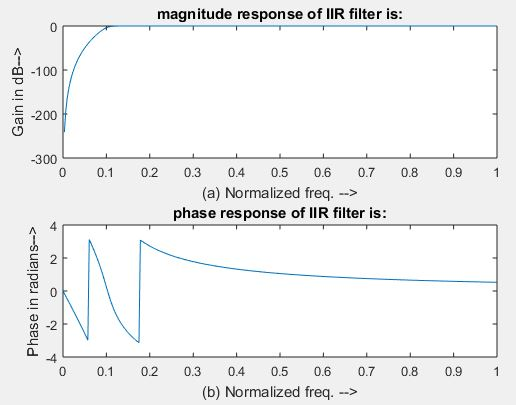
title(‘magnitude response of IIR filter is:’);

xlabel(‘(a) Normalized freq. –>’);

ylabel(‘Gain in dB–>’);

subplot(2,1,2);plot(om/pi,an);

title(‘phase response of IIR filter is:’);

xlabel(‘(b) Normalized freq. –>’);

ylabel(‘Phase in radians–>’);

output:

enter the IIR filter design specifications

enter the passband ripple13

enter the stopband ripple50

enter the passband freq1200

enter the stopband freq250

enter the sampling freq6000

CELLULAR SYSTEM

Fundamental concept of cellular system:

Let see example of cordless telephone used at home which employed wireless technology, which has less coverage and smaller amount of power. All the users use same frequency range without much inference among users. Same frequency interference avoidance is used in cellular system with much more powerful transmitting station, or base station.

Introduction to cellular concept:

A cell is defined as the use of mobile station radio communication resources is under the control of the base station. Depending on the size, shape and amount of resources allocated to each cell determines the performance of the system.

Cell area:

The important factor in the cellular system is the size and shape of the cell. Transmitter or base station coverage area is called a cell, base station serve all the mobile station connected to it in that area. Whereas the coverage area of the base station can be represented by a cellular cell with a radius R from the center of the base station. While the many factors affecting the signal strength including refraction of the signal, reflection, elevation of the terrain due to the presence of tall buildings or valleys, or hills. Received signal strength will determine the original shape of the cell. Cell boundaries are represented by using different models are hexagon, square, and equilateral triangle. From the available model hexagon mostly used model due to its arrangement style. In a hexagon, multiple hexagons is arranged next to each other, without having any spacing between two hexagons without any overlapping area. Another most popular model is a rectangular shape, which is similar to the hexagon model. If the cell area is increased the number of the channels per unit area is reduced for the same number of channels and if the populated area is less it is good which has fewer subscribers.