Connecting Devices:
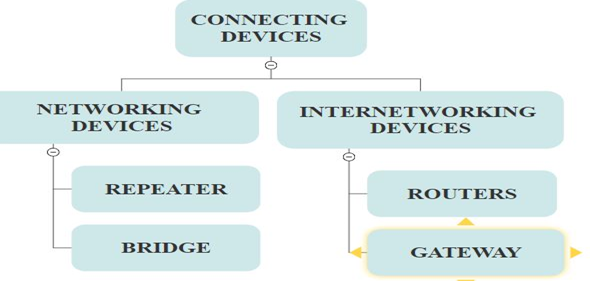
Based on high level, the connecting devices is classified into networking devices and internetworking devices. In this the repeaters are used in physical layer for providing electrical specifications for the signals.
Whereas bridges are used in the data link layer and physical layer for addressing protocols and routers will be used at the network layer which is useful for providing internetworking between compatible networks. As well as gateways are used at all layers in the OSI model for providing translation services between incompatible networks.
Repeater:
In osi reference architecture a repeater is used at physical layer in order to regenerates the signal for electronic devices.signal travelling across a physical wire travel some distance before they become weak, or corrupted as other signals noise interfere. A repeater receives such signal, which is weak or corrupted and regenerates the signal.
Working of the repeater:
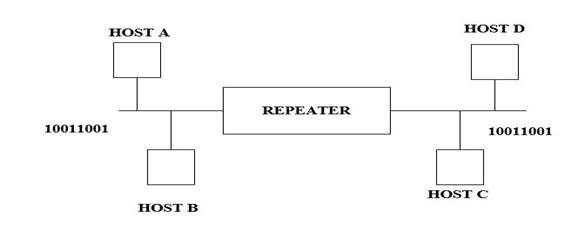
For instance let us consider a sample network (LAN), in this host A wants to send a packet having the bit stream 10011001 to host D. let check once the two hosts are on the same LAN, but on different portion of the LAN. When the host A sents a signal to host D the signal may becomes weak, with this the host D may not able receive the same signal it may get corrupted as 10011011 before it reaches to host D. however, even before this can happen, at the lowest level, the repeater simply prevents this from occurring by taking the input signal corresponding to bits 1001100. Regenerating it to make a sign with an equivalent bit format and therefore the original signal strength, and sending it forward.
Bridge:
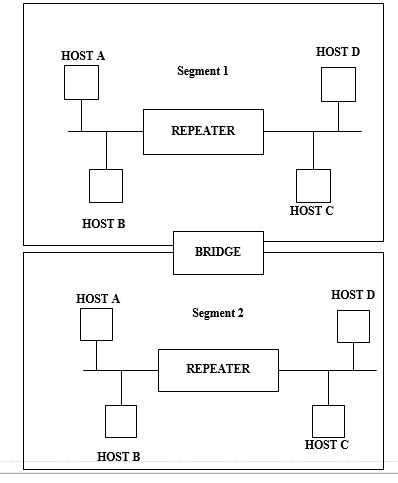
It is operated at both physical and datalink layer of the OSI protocal hierarchy. Bridge consisting of computer with it’s own processor and memeory card, two NIC cards to connect to two portions of a network.
The main intention behind using a bridge is to divide the entire larger network into smaller subnetworks, known as segments.
Purpose switching to bridge:
Unnecessary traffic is minimized, links in errors are identified and isolated so that the traffic does not go through it. Security features or access control can be implemented.
Routers:
Router is operated at three layers in OSI model,which routes the packets based on their logical address.router normally used to connect LAN and WAN in the inernet and routing table is used to take decisions about the routes. They are usually dynamic and require routing protocals in order to update.
Gateway:
Gateway is operated at the seven-layer in the OSI model and five layers on the internet. A gateway takes an application message, read it, and interrupt it. It can be used as a connecting device between two internetworks that use two different models. Let’s consider an example, well a network is designed to use an OSI model that can be connected to another network using the internet model.